CT-based cannabis company buys remaining equity stake in European holding company. Curaleaf Holdings Inc., a Stamford-based cannabis company, has …
Tag: Northeast
-
CT-based cannabis company buys remaining equity stake in European holding company
Curaleaf Holdings Inc., a Stamford-based cannabis company, has bought an institutional investor’s equity stake in Curaleaf International Holdings …
-
What Gives Marijuana Strains Their Distinctive Smells And Flavors? A New Scientific …
Ben Adlin, a senior editor at Marijuana Moment, has been covering cannabis … Rhode Island Marijuana Regulators Seeking Applications For New Dispensary …
-
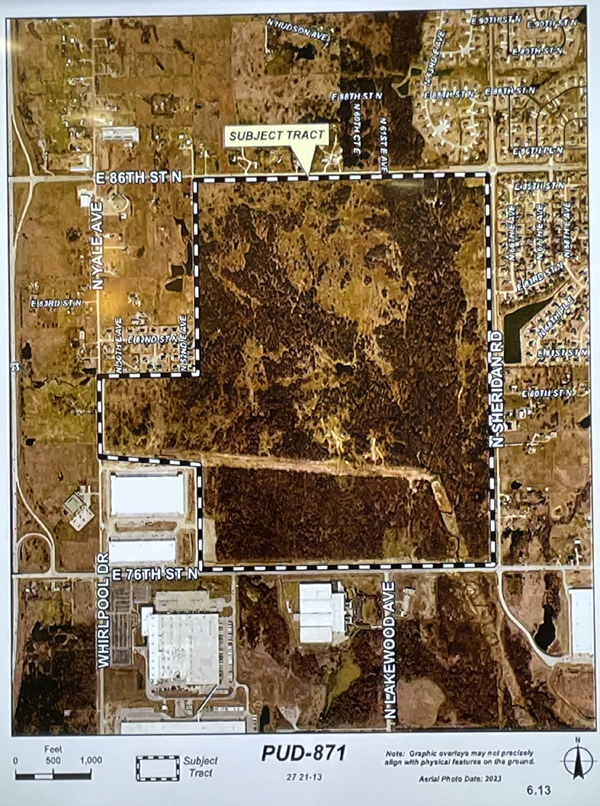
Tulsa County Data Center Opposed
Citizens rallied with strong opposition Monday to a proposed data center on 506 acres of undeveloped land in Tulsa County just north of the Cherokee Industrial Park and directly west of significant well established residential neighborhoods. The power-elite were also in attendance at the Tulsa County Board of Commissioners meeting.
County Commissioners tabled the vote on the zoning change from agricultural to light industrial until a special meeting Wednesday, July 16 in apparent response to public outcry.
Representing developer Beale Infrastructure, Attorney Lou Reynolds, Eller & Detrich, is known for representing despised development and is often successful as an agent. He announced, at the meeting, the project would likely be owned, after completion, by Google, Microsoft, Amazon or Meta.
Reynolds online, claims demonstrated community leadership as trustee of the Tulsa Metropolitan Utility Authority, the Tulsa Utility Board, the Regional Metropolitan Utility Authority and the Tulsa Authority for the Recovery of Energy, and as chairman of the Tulsa Chapter of the National Association of Industrial and Office Parks.
In the photo below, Reynolds is seen taking notes seated between Rich Brierre, Executive Director, Indian Nations Council of Governments (INCOG) on his right and Kim Wilmes, Senior Vice President of Economic Development for the Tulsa Regional Chamber on his left.
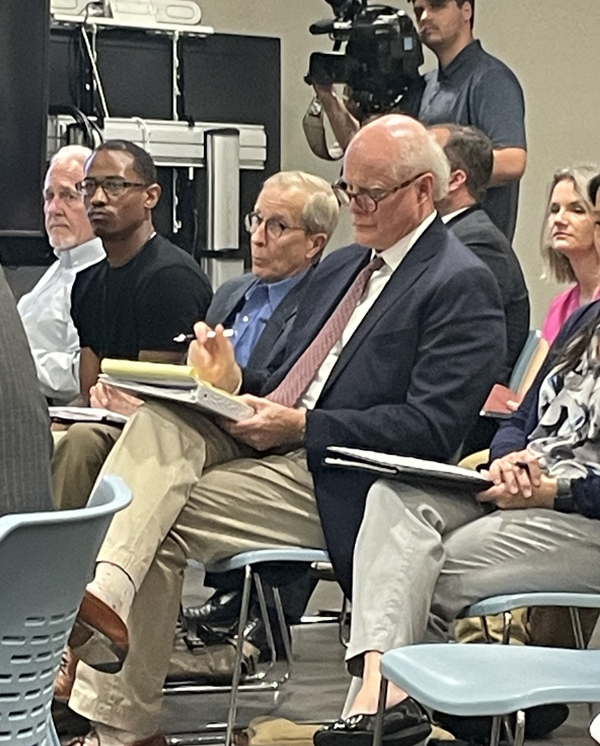
The Tulsa Metropolitan Area Planning Commission, staffed by INCOG, voted 10-0 in June to recommend approval of the zoning change. County Commissioner Stan Sallee is currently the Chair of the INCOG Board of Directors, a former Collinsville Mayor and residential developer in the North Tulsa County area.
Wilmes expressed Chamber support for the project, saying, “We continue to be supportive of industrial projects, and this one, specifically, as it’ll create up to 200 jobs in the tech sector, paying higher-than-average wages.”
Citizens questioned that employment number, suggesting Wilmes included temporary construction workers. Typically, a data center may employ a few dozen or more depending on the scale of operations and service provided. No details on scale or service has been publicly revealed for this proposed facility.
Kennedy LaPlante, director of youth outreach for OKGOP, a Sperry resident living one mile from this development, said that more than 330 people in the last 24 hours had signed an online petition in opposition to the project and people were outraged over the plan.
To reach the petition, click on the following link: https://docs.google.com/forms/d/e/1FAIpQLSd4RubnA8tV9ijZ3rwzQ2zKFkDtDCBOxze37wMCjV4mpciulg/viewform?pli=1
Citizen speakers repeatedly said they had not received notice of the development. Reynolds told the County Commissioners that a communications company had been hired to contact neighbors. After the meeting, Reynolds identified the company as Propeller Consulting, but when contacted the president of the company said, “I’m not an authorized spokesperson for this project.”
LaPlante said, “The Commissioners kept looking to the attorney to answer questions as if they didn’t know anything about the project. We believe it will be an environmental hazard and negatively impact generations to come. Until we see credible environmental experts report on the risks, we must insist this project be halted.”
Area neighbor Sabrina Ingram said she wanted time to gather expert testimony from those on the “other side” of the issue to address long-term energy, health, and public safety impacts.
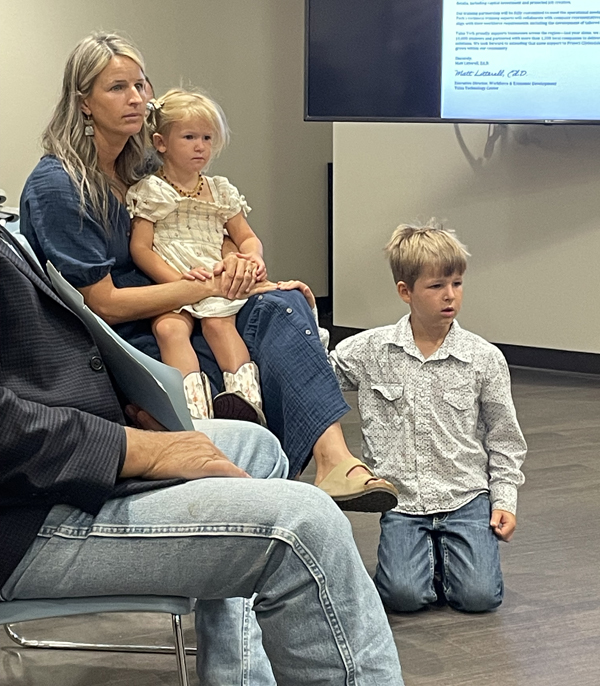
Sabrina Ingram and her children paid close attention 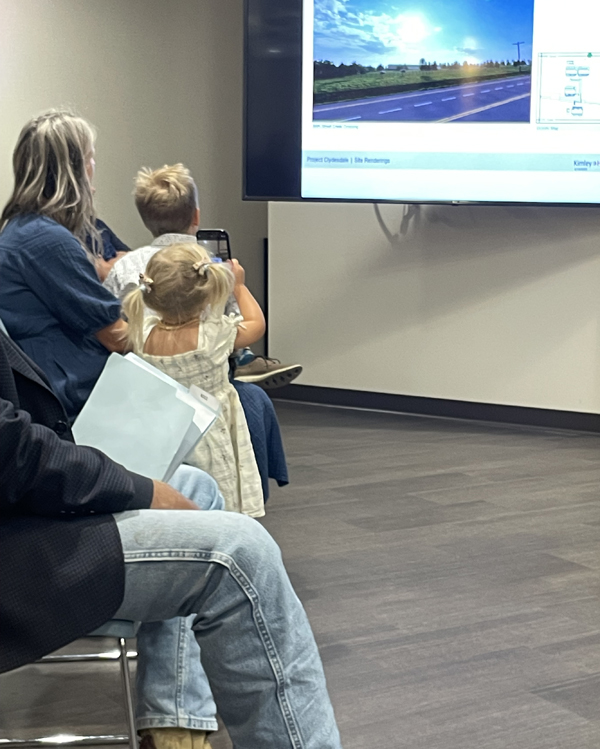
The little Ingram took a phone photo of project art Neighbor Randall Barnett said, “I think Commissioner Kelly Dunkerley did very well for the people and took to heart what we had to say. I wish the other commissioners had tabled the issue longer, as he requested, to do their own due diligence.
“The presentation was very one sided and the actual demand for cooling water in hot Oklahoma Summers for industrial use may outstrip our resources. This is my view from reading published work by Navy Nuclear Technician Mark Trump on the east coast who has worked on modular reactors which this project may eventually require,” Barnett added.
Significant concerns were voiced about the data center’s water demand, with claims from Rural Water District 3 minutes indicating 7.5 million gallons/day requested, while the sewer system was cited as only able to handle 2 million gallons/day.
Worries centered on water contamination from cooling processes, as chemicals used make the water no longer usable and current knowledge lacks the means to properly clean for reuse (e.g., for drinking, agriculture, livestock, or personal gardening).
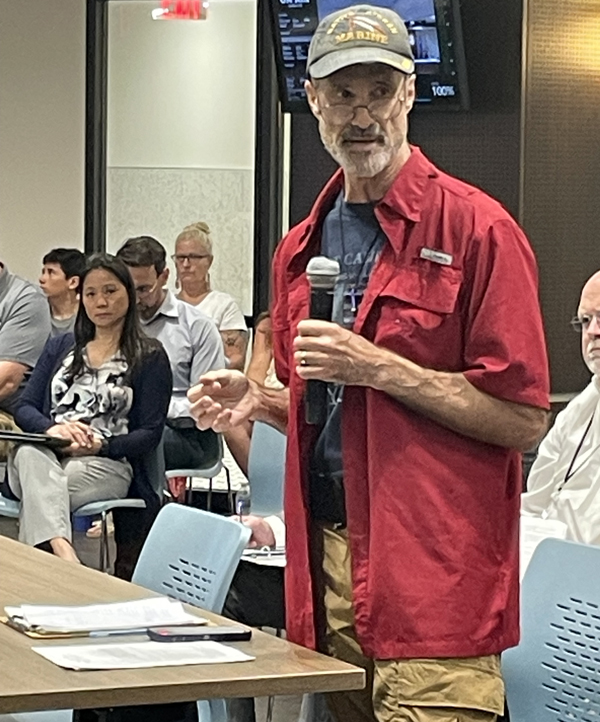
Randall Barnett questions development Residents expressed concerns about potential negative impacts on agriculture, livestock (dairy cows, beef cows, chickens), ranch lands, hay production, and local food production.
Reference was made to existing issues in Muskogee, Oklahoma, where a similar data center is reportedly dealing with leaking contaminants.
FOX 23 has posted the full 48-page application on the new data center for the zoning change, click here for that report. KOTV’s much shorter story may be found by clicking here.
As many have discussed statewide, major money is often made by planning and zoning committees for various causes, some good for the people and some good for some people. It is past time that those conversations be held in public and on platforms like FOX 23 and KOTV Channel 6 in Tulsa. Both covered both sides. The print propaganda outlet of course was… typically convoluted.
What are Oklahomans willing to pay for promised “economic development?” Shall we talk about electric vehicles, Kaiser’s Solyndra deal or whatever some salesman wants to promote, “right here in river city.” How about we sell Kansas and keep Oklahoma land?
While Oklahoma’s Favorite Son, Will Rogers, is often credited with the quip, it was first an old gentleman in Kansas in 1905, October 13, “Buy land … God almighty isn’t making any more land.”
In 1930, April 13 Will Rogers did say,” I had been putting what little money I had in Ocean Frontage, for the sole reason that there was only so much of it and no more, and that they wasn’t making any more.”
Rogers might note today that we are still having babies and more people want to move to Oklahoma (leaving Blue State Blues behind), so how should we use our limited resource of land. Maybe a full public discussion is required between residential and industrial rather than a rush one way or the other for 100 or 500 or 30,000 acres. Or what about building these data centers on old abandoned commercial or industrial land – true urban renewal rather than rural betrayal?

-
Appeal filed in Nebraska medical cannabis preemption case | News From The States
… cannabis program because of federal law classifying marijuana as a Schedule I drug. … Rhode Island · R.I. Turnpike & Bridge Authority to pay $515K for …
-
Welch: Federal debt + spending = we’re living beyond our means
I’m a finance professor at UCLA, so let’s talk finance. Which numbers are more meaningful to you?
Having $50 to $100 cash in your pocket (rough average for an American) or knowing the total U.S. currency in circulation is $2.4 trillion?
Owing $7,300 on your credit card (average balance of those who don’t pay it off every month) or envisioning the total U.S. credit card debt of $1.2 trillion?
Being $250,000 in debt on your home (average among American consumers with a mortgage) or seeing that the nation’s total residential consumer mortgage debt is $12.8 trillion?
Holding $250,000 in your 401(k) or IRA account (average for baby boomers, now old enough to need it soon) or knowing the total U.S. savings in such accounts is about $27 trillion?
Receiving a monthly Social Security check of $2,000 (the average) or considering the balance of the Social Security trust fund at $2.7 trillion?
I’ve been researching and teaching economics for more than 30 years, and still I can’t wrap my head around trillions of dollars. I’m guessing you can’t, either — and neither can our senators and representatives who determine the federal budget. And yet, our government insists on communicating with us in this unfathomable language.
Worse, even our best media outlets rarely translate the government’s incomprehensible abstractions into understandable numbers, giving us sentences like this one from the Wall Street Journal: “President Trump’s tax-and-spending megabill would increase budget deficits by $2.4 trillion over the next decade, compared with doing nothing, according to a Congressional Budget Office estimate released Wednesday.” (By the way, that figure has been revised to $2.8 trillion as of June 18 — as if the human mind could comprehend the difference between those boggling figures.)
And so I want to help people understand both our federal budget deficit and the resulting national debt, as well as our government’s free-spending ways. (Both parties are to blame; no need for politics here.)
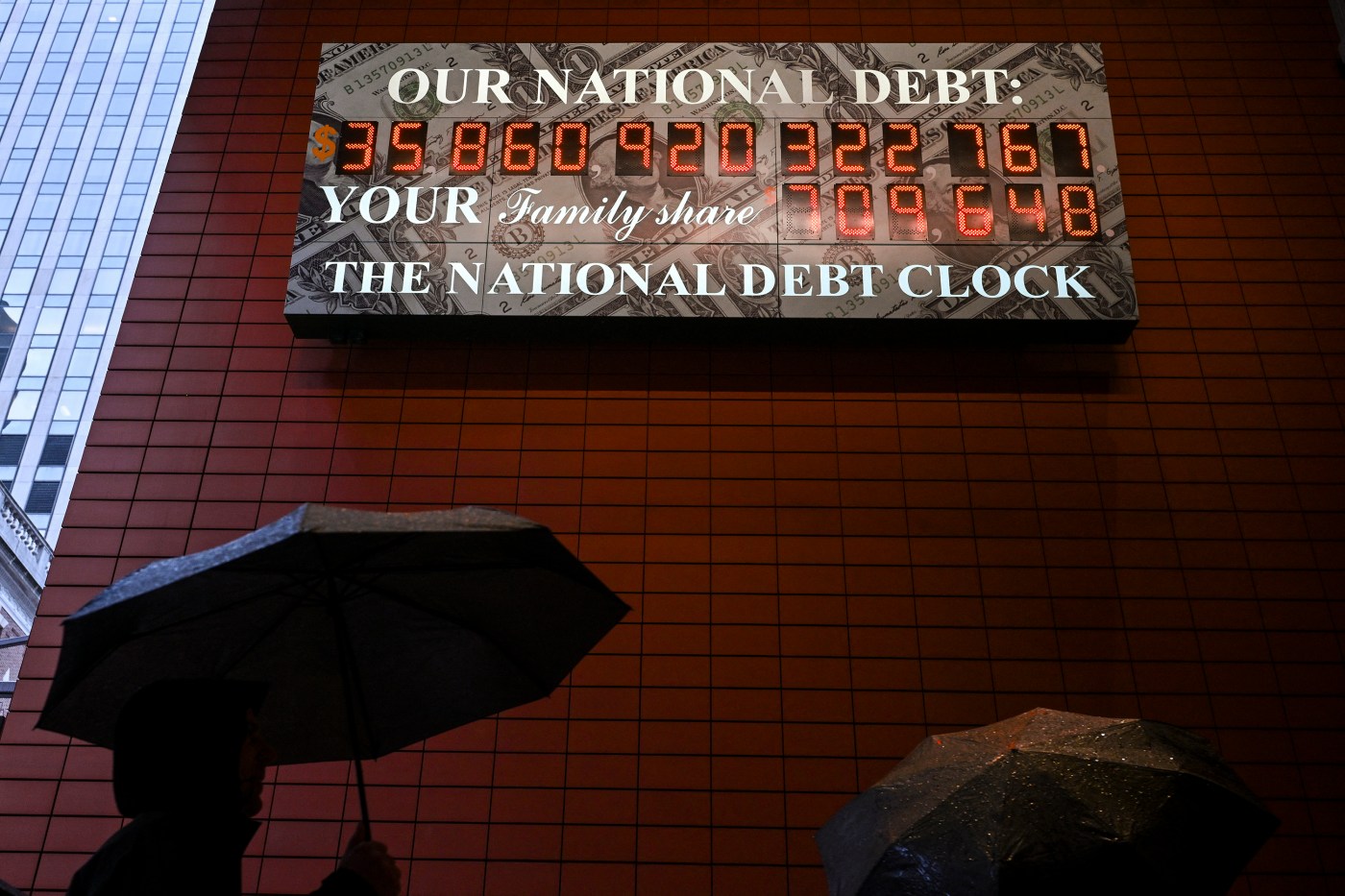
The national debt today stands at about $37 trillion. This means that each of our 347 million people is on the hook for about $110,000, or about 2.75 years the median income of $40,000 per year.
Of course, not every U.S. resident earns income or pays income tax. With “only” 154 million taxpayers, this means that the average taxpayer’s piece of the $37 trillion federal debt is about $240,000, or six years of the median income.
Think of this as your share of our federal debt. The government may have borrowed it, but ultimately you are on the hook for it. Feel better now? Probably not. For most people, learning that you owe $240,000 is a lot more concerning than hearing that the national debt is $37 trillion.
And your piece of our collective problem is still growing. Each year, our federal government takes in about $35,000 per taxpayer ($5 trillion) and spends about $45,000 per taxpayer ($6.75 trillion). Lawmakers are currently not paying down our debt but adding about $10,000 per taxpayer every year to our already outstanding balance of about $240,000.
Unfortunately, we have another problem. Our outstanding debt was issued at low interest rates (around 2.3% per year). This is about to change. When it comes due, refinance interest rates will likely be more like 4% per year. Federal spending on interest will rise from the current level of about $6,000 a year per taxpayer to more like $10,000.
Back to the “One Big Beautiful Bill” that the Wall Street Journal was reporting on. Roughly speaking, over 10 years, the Congressional Budget Office estimates the legislation will add a total deficit of $18,000 per taxpayer. Whatever debt balance we expected to reach in about 10 years, under this new budget, we would be expected to reach that debt in nine years.
In itself, debt isn’t so bad. For instance, as your home’s value grows, the mortgage percentage shrinks. If your income rises, that helps, too. Our 25-year-old business school students, who have no current income but take on a six-figure debt, can typically comfortably pay off their debts and support a nice lifestyle, too.
Unfortunately, not so for our federal malaise. Our income and tax bases are growing nowhere near as fast as our obligations.
With growing deficits and rising interest rates, we are instead accelerating our obligations. Adding in our running deficits, even if we assume that we can greatly increase our economic output, tax base and tax intake, and that there will be no recession, and that tariffs will cover about one-third of our deficits (a combination that few economists believe), we are still heading straight for a date with a metaphorical bankruptcy judge. Fortunately, this is legally impossible.
So what can possibly happen?
First, we could get exceedingly lucky: Economic growth could reach higher than it has ever been.
Second, our politicians could raise taxes, curb spending or do both. However, we have no collective appetite for this. (Those actions could slow growth to the point that they become counterproductive.)
Third, we could “print” money. However, this would leave us in a fiscal situation similar to that of many developing nations, with galloping inflation and untrustworthy currency. Who would then lend us money? It surely wouldn’t “make America great again.”
Living beyond our means is not a Republican or a Democratic problem. Our parties may disagree about what to spend the money on, but both show by their actions that they agree spending more is better than spending less. Politicians are reflections of their electorates, and we the people are not ready for any pain. If our voters can begin to comprehend our problem, we’ll be on our first step toward a solution.
Ivo Welch is a professor of finance and economics at the Anderson Graduate School of Management at UCLA./Tribune News Service
-
Flintstoned – mg Magazine
Designing the Ultimate Showcase When Mike Flynn set out to create New York’s most ambitious dispensary, Display Dispensary delivered a custom …
-
Detroit mentor charged with giving marijuana gummies to teens at Juvenile Detention Center
… marijuana gummies. Read: https … New York Post New 3.9M views · 1:15:30 · Go to channel · Dave …
-
Bridgeport Discovers the Power of Full-Spectrum High-THC Small Batch Weed from NY
Bridgeport residents are finding out what New York cannabis consumers already know—Silly Nice is changing the game with its high-potency, …
-
Mass. Cannabis Lab Calls Shutdown Order ‘Unlawful’ – Law360
A cannabis testing lab asked a Massachusetts judge on Monday to let … Florida Food & Beverage Georgia Government Contracts Health Illinois