NEW YORK CITY – The NYC Charter Revision Commission (CRC) will hold its … As cannabis use became more common in the late 1970s, the …
Author: Extroverting
-
2025 Law Power List: M – Z – NJBIZ
… New Jersey Cannabis Regulatory, Enforcement Assistance and Marketplace Modernization Act. Today, he counsels clients on corporate formation and …
-
Ohio is expected to be a key growth driver in national marijuana market
Ohio’s licensed marijuana market appears to be an outlier among the 24 states that have legalized cannabis … New Jersey. RECOMMENDED FOR YOU. “” Ohio …
-
Why Do Republican Lawmakers Keep Trying To Overturn Marijuana Laws Approved By …
… cannabis reform legislation this spring. In fact, the only marijuana-related bill approved by Florida lawmakers this year was legislation denying …
-
Mississippi Medical Marijuana Laws 2025 – How to Qualify & Buy Legally
… Marijuana Legal in Florida? Here’s Everything You Need To Know About the Sunshine State’s. Florida Cannabis. Is Weed Legal in Florida in 2025? Medical …
-
Legal weed continues to divide Pa. Republicans – Spotlight PA
… Marijuana Laws, said that the fee is relatively low compared to neighboring states such as New Jersey, which can charge up to $1 million.
-

OU Welcomes Criminal Invaders
According to a story by Clarise Tujardon ’26 published Friday, July 18, on Campus Reform, “the University of Oklahoma (OU) in Norman continues to provide services for illegal alien students through its admissions and financial aid processes” the Texas Correspondent wrote.
On its web page, OU’s Undocumented Admissions describes itself as a “safe place” and a “source of information and guidance” for illegal immigrants on how to apply to the university. It includes step-by-step instructions on application routes, tuition eligibility, and financial aid status.
“In the Office of Admissions and Recruitment, we do our best to find and provide the resources to better serve undocumented and DACA students as they are students who work hard to pursue their education and deserve access to higher education and become members of the OU family,” the website reads. “This is a safe place.”
Tujardon continues:
“The University of Oklahoma welcomes all undergraduate and graduate applicants regardless of citizenship status,” the site states.
Applicants using the OU Application can self-identify their immigration status as the Common Application will not give the option to list themselves as “undocumented.”
For the Coalition with Scoir application, the university instructs students to select “Other (Non-US).”
Graduate applicants are told to choose “citizen” or “permanent resident,” and then notify the admissions office of their actual status.
The university acknowledges that illegal immigrants are not eligible for federally funded financial aid, including loans, grants, or work-study programs. However, under Oklahoma House Bill 1804, students who attended high school in Oklahoma for at least two years with a parent or guardian may still qualify for in-state tuition through an Affidavit of Intent.

According to the website, illegal immigrants are also eligible to apply for state and university scholarships if they “provide the institution a copy of a true and correct application or petition filed with the United States Citizenship and Immigration Services to legalize their immigration status.”
OU’s website also reassures such students that the university has “processes in place that assist in making OU possible.”
In response to Campus Reform’s request for comment, a spokesperson for the university’s Admissions and Recruitment office referred to an Immigration FAQ web page.
This comes as the federal government has increased scrutiny of public assistance for illegal immigrants.
In June, the Department of Justice sued Minnesota for providing unlawful tuition benefits to non-citizens, claiming that the scholarships given to illegals “unconstitutionally discriminate against U.S. citizens.”
Campus Reform has also reached out to the Oklahoma State Regents for Higher Education.
Tulsa Today congratulates Clarise Tujardon on her public reporting and hope Oklahoma students will become just as curious. We also called the Board of Regents and were referred to the media and communications office. Tulsa Today was then directed to send an email requesting a statement. We will update this story when that statement arrives.
We note Board of Regent emails are posted on a contact page for those readers who might like to communicate directly with them on this or other issues.
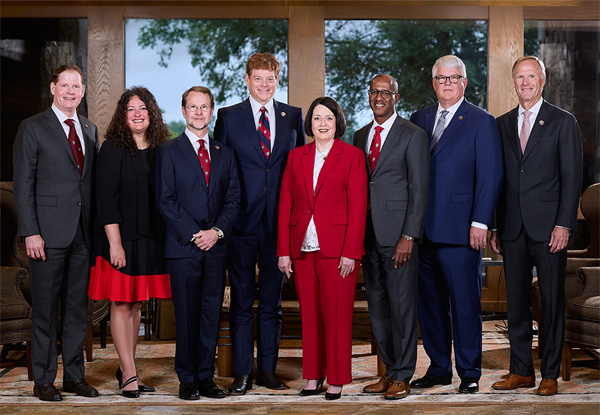
Left to right: Robert J. Ross; Mackenzie Wilfong, Executive Director of the Board; G. Rainey Williams, Jr.; Rick Nagel, Vice Chair; Anita L. Holloway, Chair; Eric Stevenson, Past Chair; John R. Braught; and, Kenneth S. Waits Anita L. Holloway
[email protected]Rick Nagel
[email protected]Eric Stevenson
[email protected]Robert J. Ross
[email protected]John R. Braught
[email protected]Kenneth S. Waits
[email protected]G. Rainey Williams, Jr.
[email protected] -
Connecticut AG Announces First Settlement Under The Connecticut Data Privacy Act
On July 8, Connecticut Attorney General William Tong announced a settlement with TicketNetwork, Inc. for alleged violations of the Connecticut …
-

Leveling the Playing Field: How Smaller Retail Media Networks can Win Big with First-Party Data
Retail media is exploding. U.S. ad spend surpassed $50 billion in 2024 and continues to climb, yet the market’s spoils aren’t evenly distributed. Amazon and Walmart are raking in the lion’s share, commanding about 85% of all retail media ad spend. But that leaves a major opportunity for smaller and mid-sized retail media networks (RMNs) to stand out if they focus on what advertisers care about most.
As a former media buyer, I didn’t need another walled garden with maximized reach. I had plenty of those. I needed a partner who could give me a strategic advantage. For mid-sized RMNs that advantage isn’t scale, it’s the weapon you already own: granular, high-intent, first-party data.
The temptation might be to mimic the giants, but that is a losing strategy. The real opportunity lies in out-thinking and out-maneuvering them.
Just because you’re not one of the giants doesn’t mean you’re out of the game. In fact, many of these emerging and midsize RMNs serve audiences that the big players can’t reach: loyal customers with high purchase intent, people who engage regularly through loyalty programs, mobile apps and at the point of sale.
Forget about playing catch-up. This is the moment to leap ahead.
First-Party Data: Retail’s Undeniable Advantage
Regardless of how third-party cookie policies unfold, the advertising industry’s focus is irrevocably shifting toward higher-quality, more reliable data — and not just for targeting, but for measurement, optimization and building trust. Just having the data is meaningless. Its value is determined based on how easily advertisers can access it and what advantage they can get out of it.
Smaller RMNs already have that: Their first-party data is clean, opt-in and derived directly from customers who choose to engage. Your data — loyalty scans, app behavior, point-of-sale insights — is rooted in actual purchases, not just probabilistic signals. That is your core product. Neglecting to make it accessible and actionable is hurting your business.
Unlike fragmented third-party data, first-party data is coherent, consistent, actionable and compliant with modern data privacy expectations.
So why aren’t more RMNs putting data to work? Nearly 70% of buyers cite a complicated buying process as a barrier to growth. But clarity starts with data, and 90% of marketers agree: first-party data is essential.
That’s a missed opportunity for advertisers who now prioritize:
- Targeting accuracy through first-party data;
- Incrementality measurement tools to prove lift;
- Self-service buying platforms for agile activation;
- Robust documentation and APIs for seamless onboarding; and
- Clear paths to scaling after successful tests.
Put simply, the RMNs that win are the ones that make it easy for advertisers to test, measure and scale.
Smaller Doesn’t Mean Weaker. It Means Sharper.
There’s a growing realization in the ad world: It’s not just about how many people you can reach, it’s about reaching the right people. And that’s where smaller RMNs really shine. Just like a small ship, a smaller RMN can shift and pivot more easily than a freighter.
Their audiences are often more engaged, more loyal and more niche, which makes them incredibly attractive to advertisers hungry for precision. Precision demands strategy, technology and crucial integration.
As a media buyer, I would have loved niche data that captures my target group perfectly. Let’s say you’re selling quality scissors to crafters and teachers: If you have an RMN where primary buyers match that profile, that’s gold to me.
Retail media networks run on data, but too often that data is fragmented. Loyalty insights in one system, ecommerce behavior in another, in-store transactions somewhere else. This disjointed picture weakens full-funnel attribution and slows down decision-making. We see this every day. The average customer uses data from four distinct sources. Stitching those together is no longer a nice-to-have; it’s essential.
With the average company juggling over 2,000 data silos, integration isn’t just a technical task; it’s a strategic imperative. Fragmented data clouds insights and limits performance, while connected data empowers teams to move faster, report smarter and drive more value for advertisers. Bringing it all together isn’t just a cleanup. It’s leverage.
Integrated data can:
- Unlock deep segmentation, letting you target messaging based on individual SKUs, behaviors or even loyalty tiers;
- Deliver unified insights, giving advertisers a clear view of both online and offline performance;
- Speed up optimization, allowing real-time adjustments that keep campaigns agile and effective; and
- Build trust, because advertisers can actually see how their dollars are working.
In a market where every impression counts, integration turns insight into advantage.
Smart Beats Scale
Let’s be clear: The goal isn’t to beat Amazon or Walmart, but to play smarter. Instead of trying to build another version of Amazon Ads, mid-sized RMNs should look outside their own market to the hyper-competitive markets in APAC for inspiration. Players like Rakuten in Japan or Grab in Southeast Asia didn’t win by copying Western models. They won by building deeply integrated ecosystems around their unique first-party data, from ride-sharing and food delivery to ecommerce and financial services. They made their data their undeniable advantage and built their platforms to cater to their advertisers’ needs.
The lesson is clear: Your technology stack is your product. Invest in infrastructure that connects your data and makes it actionable — an advertiser will see the value of an automated, customizable dashboard, not hunt for a 10-page PowerPoint.
With 46% of marketers already using AI for optimization, the message is clear: The faster you can apply insights, the more attractive you’ll be to advertisers. By surfacing patterns faster, predicting shopper behavior and recommending next steps, AI can take good data and make it smarter, faster and more scalable. Done right, data becomes your differentiator, not just in what you know, but in how fast you can apply it.
Smaller RMNs cannot afford complacency. They’ve got to take the offensive: own their data and optimize their tech stack by investing in modern data infrastructure; that is, systems built to integrate, automate and scale. By unifying disparate data sources and streamlining delivery into analytics environments, they lay the foundation for the strategic sophistication today’s advertisers expect.
The retail media landscape is littered with thousands of potential media sources. To a media buyer, a mid-sized RMN is just one more line item on a sprawling plan. You will not win on scale. You will not win by being a little bit cheaper. You will win by being smarter, more precise and radically easier to work with. This starts and ends with your data infrastructure.
The potential, the audience and the data are there. The missing piece is the infrastructure to bring it all together: the modern data stack built to integrate disparate sources, automate reporting and stream insights directly into the analytics environments where decisions are made. Waiting isn’t a strategy; it’s a delay that equals lost ground in this fast-moving space.
The future of retail media will be built on precision, trust and performance. This is a future where smaller players compete not by sheer size, but by leveraging superior insights, agility and a truly connected strategy to secure their undeniable seat at the table.
Outi Karppanen is the Lead Marketing Industry Strategist at Supermetrics, where she brings over a decade of experience in digital marketing and data strategy. She thrives in collaborative environments, working closely with sales, marketing and product teams to tackle complex marketing challenges. Karppanen specializes in developing compelling industry narratives, forging strategic partnerships and empowering internal teams with the insights and tools they need to drive impact.
-

MarTech Series’s Marketing Technology Highlights of The Week Featuring Twilio, Chatmeter, Sitecore and more in martech!
Don’t miss the latest in martech, from Twilio’s enhanced platform capabilities to Zendesk’s new acquisition from this week’s martech highlights:
___________
Marketing and Marketing Tech Quote-of-the-Week!
Personalization is often treated like a switch: you either have it or you don’t. In reality, personalization is a spectrum. At one end, it’s a first name in a subject line. Technically personalized? Sure. But meaningful? Not really.
Top MarTech News of The Week – 14th July to 18th July, 2025
- Lucidya Raises USD30 Million in Largest AI Funding Round in MENA
- Zendesk Announces Acquisition of HyperArc, Ushering in Next-Generation, GenAI-Powered Analytics Platform
- Twilio Expands Platform Capabilities with General Availability of Real-Time Personalization, Data Residency Control, and WhatsApp Business Calling
- Chatmeter Launches the First Real-Time Competitive Intelligence Platform Built for Multi-Location Brands
- New Findings from Data Axle Reveal the Marketing Disconnect: Brands Still Don’t Understand the Whole Customer
- Unify Raises $40 Million Series B to Transform Go-To-Market with AI
- Backstroke Lands $2.8M, New Executive Talent, and Announces Upgraded Features Amid AI Marketing Boom
- Sitecore Scales Global Partner Ecosystem with New Diamond Tier, Strategic Expansion in Iberia, and Annual Partner Awards
- OpenX Announces OpenXSelect, an Advanced Supply-Side Targeting and Curation Platform for Brands and Agencies
- WunderKIND Ads Revolutionizes CTV Advertising With Introduction of New High-Impact, Programmatic Pause Ad Product
- Bonsai Secures $1.8 Million Investment for First-Party Marketing Intelligence Platform
- AppsFlyer Debuts AI-Powered MCP to Streamline Data Access and Campaign Execution
- Edge226 Announces Acquisition of Adscend Media to Strengthen Performance Marketing Platform
Top MarTech Articles on CTV Ads, Data for Impact, B2B Marketing Content Tips and more!
- From Data to Impact: How AI is Transforming Interactive CTV Ads
- Why Your CTV Advertising Strategy Can’t Wait — and How to Make It Count
- Why More Marketers Are Turning to Owned Media to Stay in Control
- Cross-Department Collaboration with Marketing Workflow Automation: Enhancing Alignment Between Sales, Customer Service, and Marketing Teams
- Power of User Generated Content in B2B Marketing – Integrating User-Generated Content into Your B2B Marketing Strategy
- Cross-Department Collaboration with Marketing Workflow Automation: Enhancing Alignment Between Sales, Customer Service, and Marketing Teams
MarTech Q&A of The Week
Read More It’s easy to get caught up in content velocity, but quality and compliance matter more than ever. Marketers should ensure their AI tools can reason over approved assets, brand guidelines, and messaging frameworks.
–Meena Ganesh, Senior Product Marketing Manager at Box AI
Missed The Latest Episode of The SalesStar Podcast? Have a quick listen here!
Episode 229: The Future Of Digital Customer Journeys with Monica Ho, CMO at SOCi
Episode 228: Gamification for Better Sales Orientation with SalesScreen CEO – Sindre Haaland
Episode 227: Revenue Generation and RevTech Trends: with Latane Conant, CRO at 6sense