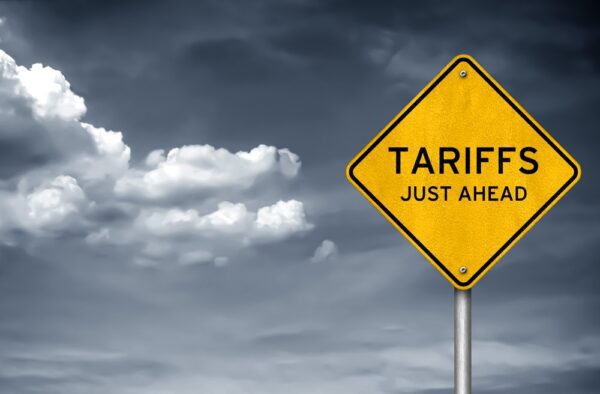
It’s becoming clear that “tariffs,” a word that just a few short months ago was more familiar to economic historians than the general public, has become shorthand for “economic uncertainty and volatility.” The tariffs themselves are disconcertingly fluid at the moment, with tariff types and amounts seemingly changing on a daily basis. And tariffs’ strongest proponent, President Trump, may be losing his enthusiasm for them; the April 25 New York Times’ front-page story said Trump has “blinked” on tariffs after being faced with a number of economic realities.
These realities included warnings from the CEOs of Walmart, Target and other leading retailers who met with the President earlier this week, telling him that tariffs would lead to higher prices and empty shelves during key selling seasons such as back-to-school and holiday, according to MSNBC and other media outlets.
Stocking up Ahead of Tariff-Spawned Price Hikes
In some ways, the uncertainty is worse than whatever the actual economic impact of the tariffs may end up being. Immediate impacts have included retailers filling their domestic warehouses ahead of the actual imposition of tariffs, a move that makes good business sense, according to John Harmon, Senior Retail/Technology Analyst at Coresight Research.
“It’s prudent for retailers to [fill domestic warehouses] during this window,” said Harmon in an interview with Retail TouchPoints. “You might have to discount later, but that’s as opposed to waiting and potentially not getting enough product and disappointing customers. With such a high degree of uncertainty, it’s better to stock up even if [tariffs force] a 10% margin hit now.” He added that in most cases the math would continue to work even if retailers are later forced to discount these products in order to achieve sell-through.
Consumers also appear to be buying now in anticipation of higher prices down the line, although consumer sentiment and the reasons for making purchases are both tricky thing to measure. The National Retail Federation (NRF) quoted Census Bureau figures showing that March 2025 retail sales climbed 1.4% seasonally adjusted month-over-month and rose 4.6% unadjusted year-over-year, compared to 0.2% and 3.5% increases, respectively, in February.
Major Hit to Consumer Wallets
While noting that we are still in “unknown territory,” Heather Rice, Tax, Consumer and Retail Sector Leader at KPMG, said during an April 9 webinar that “we expect consumers’ wallets to be hit by $6,000 [in extra costs] this year, and we’re not even talking about electricity or car insurance rate hikes. It will affect lower- and middle-class households more, so how consumers and businesses respond will be critical.”
Household budgets already are stretched thin, according to a consumer survey of 2,000 consumers and over 100 retailers conducted by Rakuten. “36% of consumers can afford both daily expenses and non-essential items, but that means there’s a huge swath that cannot, and they are now making strategic decisions regarding essential and non-essentials,” said Julie Van Ullen, Chief Rewards Officer at Rakuten in an interview with Retail TouchPoints. “19% can’t afford to pay their household bills and 17% can’t afford necessities like food and gas.”
Belt-tightening already has begun: “We’ve already seen consumers cutting back, shifting to private label, buying chicken versus steak and forgoing experiences like restaurants, travel and concerts,” said Harmon.
Encouraging Sales Now Before Prices Rise
Even so, there are opportunities for retailers to encourage purchases in the short term. “We still need to meet a value-seeking consumer,” said Van Ullen. “The question becomes, how can retailers get in front of the consumer right now with sales, discounts, offers and loyalty program benefits while they are in a ‘buy now’ mentality?”
Cashback programs like Rakuten can be a useful tool as well: “Many retailers think about cashback as a way to heighten promos and discounts, but we also have the luxury sector, which views us as a way to push full-price sales,” said Van Ullen. “The mindset of many retailers is to use ‘levers’ like cashback to help.”
Still, “it’s fundamentally clear that consumers are prioritizing price above all else,” she added. “It’s not just what they’re going to buy, but where they’re going to buy it. The across-the-board sentiment is that they’ll buy their essentials at a place where they can get the most bang for their buck, even if that’s antithetical to whatever brand loyalty they may have had before.”
As During COVID, Supply Chain Diversification Remains Critical
While an oft-stated goal of tariffs is to bring manufacturing back to the U.S., this remains a long-term result — and one that ultimately may not be viable, given the international interconnectedness of supply chains for raw materials, parts and finished goods.
Manufacturers also will have to contend with U.S. labor costs, which far exceed those in China and the other Asian countries that have become the source of much of the world’s consumer goods production. “The cost of labor to build a television in Asia is about $300, but it’s three to four times that in the U.S.,” said KPMG’s Rice. “The question becomes, will people pay $3,500 for a [domestically manufactured] smartphone?
“Without substantial automation I don’t know how we bring manufacturing back,” Rice added. “It might be that even with high tariffs, it still could be cheaper to pay the tariff and import from a country like Vietnam rather than manufacture in the U.S.”
Coresight’s Harmon also noted that China directly and indirectly supports its manufacturing industries with free or low-cost loans, land grants and other benefits, and agreed that “the U.S. can’t compete with the cost of labor [in China].”
Additionally, “you need months or years to build a new factory as well as to train the technical people you’ll need, so we also need to build trade schools,” Harmon added.
Some brands already have made moves into tariff-friendly countries, as World Emblem has done with its planned Dominican Republic factory. And some of the supply chain diversification and nearshoring work that retailers and brands began with the onset of the COVID pandemic is still ongoing.
However, until these initiatives begin to bear fruit, retailers will be stuck with the same dilemma: raise prices to cover tariff-generated costs and risk losing customers, or “eat” the costs and see their margins shrink or disappear altogether. At the moment, alternatives to these scenarios are, you’ll pardon the expression, in short supply.